

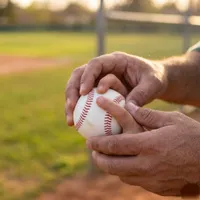
The knuckle curve is a “get-me-over” breaking ball — north-south depth that drops into the zone for a called strike and changes the hitter’s eye level. It’s the most advanced pitch in the arsenal, and the last one Coach Myles adds.
Proper mechanics
The knuckle curve gets its depth from spin and a clean, over-the-top finish — the ball tumbles forward and drops, rather than sweeping sideways. The key is throwing it with intent and a consistent release point so it finishes in the zone; a tentative breaking ball hangs, and a hanging breaker is the most hittable pitch in baseball. The delivery and arm slot stay the same as the fastball so the hitter can’t read it early.
Developing it the right way
This is the pitch Coach Myles is most careful with. The knuckle curve comes only after a pitcher has a commanded fastball and changeup, sound mechanics, and the physical maturity to handle it. That lines up with MLB’s Pitch Smart guidelines for ages 13–14, which say players can begin using breaking pitches after developing a consistent fastball and changeup. The American Sports Medicine Institute explains why the order matters: research hasn’t shown a strong connection between curveballs and elbow injuries, but a young pitcher may not yet have the maturity, control, and coaching to throw one with good mechanics. Taught at the right time and the right way, it’s a weapon; rushed before the foundation is there, it’s a risk that simply isn’t worth it.
The mindset
A breaking ball demands trust. You have to commit to the spin and trust it to finish — the cue is more tumble, thrown with conviction, not steered into the zone. A pitcher who trusts his curveball throws it for strikes; one who doesn’t, hangs it.
Every pitcher’s timeline is different. Claim a free first lesson and we’ll make sure the foundation is there before we add the breaker.